
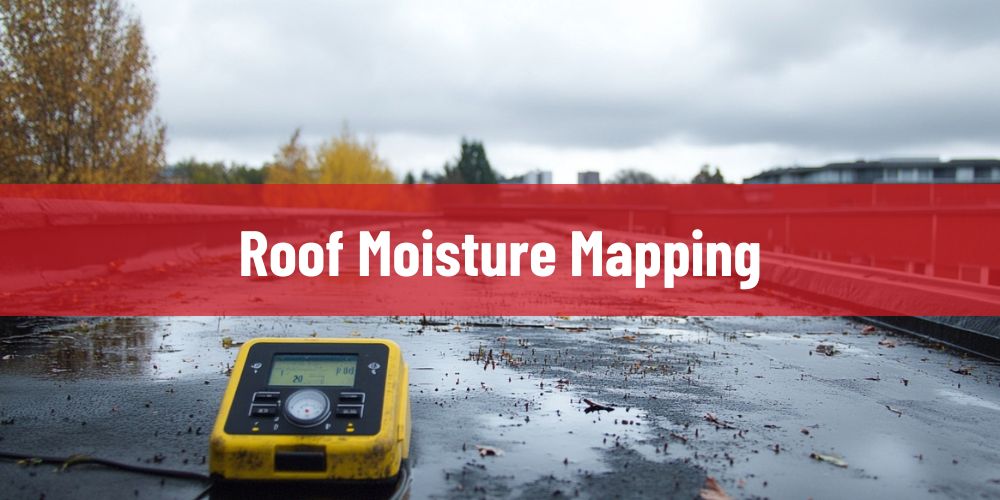
Pinpoint Leak Detection provides roof moisture mapping for commercial, industrial, residential-block, education, healthcare, hospitality, retail, logistics, and managed-property buildings across London and the South East. Roof moisture mapping is the spatial diagnostic service that identifies the extent, pattern, and severity of retained moisture within or beneath a roof system, so its value is different from simply finding the original leak source. A properly controlled roof moisture mapping survey uses non-invasive roof moisture scanning, Tramex-style wheeled moisture meters, capacitance or impedance readings, systematic scan passes, reading-zone comparison, moisture-pattern interpretation, verification points, and evidence-led reporting to show where insulation, membrane interfaces, deck zones, ponding areas, outlets, laps, rooflight kerbs, plant plinths, parapet upstands, service penetrations, terrace build-ups, or historic overlay areas may be holding moisture.
Roof moisture mapping in London and the South East operates under roof-build-up, access, occupancy, drainage, weather, and commercial-budget conditions that directly affect how retained moisture should be detected, interpreted, and converted into repair or replacement decisions. Inner London buildings often involve occupied offices, apartment blocks, schools, healthcare premises, hospitality venues, roof terraces, podium decks, plant-congested flat roofs, parapet-contained drainage zones, limited access routes, live entrances, and older roof overlays where moisture may be concealed beneath finishes, insulation, or historic repair layers. Outer London and South East properties often involve larger warehouse roofs, logistics units, retail parks, business parks, industrial estates, hotels, care homes, schools, residential blocks, and multi-building estates where saturation patterns can extend across wide roof zones, drainage runs, insulation falls, deck interfaces, outlets, plant areas, service penetrations, and repeated membrane defects. In these conditions, moisture mapping quality is determined by scan coverage, moisture meter suitability, roof construction, membrane exposure, insulation type, surface condition, weather timing, reading consistency, interpretation of moisture patterns, and how clearly the mapped results separate localised repair areas, verification points, recoverable roof zones, saturated insulation, and wider roof-system deterioration.
- Retained moisture beneath the visible roof surface → can accumulate within insulation layers, below membranes, under liquid coatings, around laps, near outlets, at rooflight kerbs, across ponding zones, around plant plinths, along parapet upstands, beside service penetrations, within terrace build-ups, and across historic overlay areas → a roof surface may appear serviceable while wet insulation, damp deck interfaces, vapour-control defects, or low-fall drainage zones continue holding moisture below the visible finish → hidden saturation, reduced thermal performance, recurring damp, corrosion risk, mould risk, heavier roof loading, and premature roof deterioration increase when moisture distribution is not mapped beyond the visible leak symptom.
- Moisture pattern shape and roof-zone behaviour → can reveal outlet-centred saturation, ponding-zone wetting, lap-line migration, perimeter tracking, parapet-side retention, plant-area damage, isolated pocketing, terrace build-up moisture, or wider insulation spread across large roof areas → the pattern of readings matters because moisture extent, not just moisture presence, determines whether a roof zone is suitable for local repair, overlay, drying, monitoring, intrusive verification, partial replacement, or wider refurbishment → repair scope, budget planning, replacement decisions, and maintenance priorities become unreliable when moisture distribution is assumed rather than spatially surveyed.
- Moisture scanner suitability and reading limitations → affect how Tramex-style wheeled scanners, capacitance meters, impedance readings, thermal imaging, core sampling, targeted opening-up, and follow-up verification should be used for the roof build-up and evidence standard → readings can be distorted by metal decks, foil-faced insulation, standing surface water, ballast, overburden, roof traffic, recent rainfall, saturated coverings, conductive components, membrane thickness, previous repair materials, and construction changes across the roof area → false positives, missed wet zones, over-repair, under-repair, disputed findings, and unnecessary strip-up increase when moisture readings are collected without method suitability checks or confirmation logic.
- Large commercial roofs and budget-sensitive asset decisions → require a clear distinction between dry roof zones, damp-risk zones, saturated insulation, localised wet pockets, high-risk drainage areas, recoverable sections, and areas that need repair, verification, refurbishment, or replacement → broad assumptions about moisture extent can either overstate the problem and inflate capital works or understate concealed saturation and leave wet build-up trapped beneath the surface → tenant disruption, capital overspend, recurring leaks, poor lifecycle planning, weak asset records, and premature roof failure increase when moisture mapping is not used to define the true extent of affected roof areas.
- Insurance, landlord, facilities, contractor, and lifecycle-planning evidence → requires mapped moisture zones, scan method, reading pattern, affected roof areas, likely spread behaviour, survey limitations, photographic records, verification points, recommended opening-up locations, and repair or replacement implications → isolated damp readings, visual inspection notes, or generic leak observations do not provide enough spatial evidence for insurers, freeholders, managing agents, contractors, maintenance teams, surveyors, leaseholders, or asset managers → disputed scope, delayed approvals, uncertain pricing, fragmented maintenance records, and poor long-term roof investment decisions increase when moisture evidence is not structured into a usable roof map.
Pinpoint Leak Detection delivers roof moisture mapping as a non-invasive moisture-distribution, roof-condition, and asset-prioritisation service, assessing internal damp evidence, roof construction, membrane system, insulation type, drainage behaviour, ponding areas, parapet and outlet details, plant congestion, rooflight and penetration risk, previous repair history, surface moisture, scanner suitability, scan path coverage, reading consistency, weather timing, method limitations, verification requirements, reporting purpose, lifecycle context, and whether the mapped findings require electronic leak detection, thermal imaging, drone roof surveying, core sampling, targeted opening-up, localised repair, insulation replacement, roof refurbishment, or planned maintenance before defining the correct diagnostic, remedial, and asset-management strategy.
What Does Roof Moisture Mapping Show Across a Roof System?
Roof moisture mapping shows how retained moisture is distributed across a roof system, not simply where a leak may have started. Pinpoint Leak Detection uses roof moisture mapping to identify moisture extent, reading patterns, saturation concentration, dry-to-wet transitions, affected insulation zones, drainage-related moisture spread, and roof areas where further verification may be required. The purpose is to convert hidden moisture risk into a spatial evidence record that can support localised repair, targeted opening-up, insulation replacement, refurbishment planning, roof lifecycle decisions, or wider roof replacement assessment.
Across London and the South East, moisture mapping is often needed where roof build-ups, access conditions, drainage behaviour, occupancy, and repair budgets make visual judgement unreliable. Inner London buildings may involve roof terraces, podium decks, occupied offices, apartment blocks, schools, healthcare premises, hospitality buildings, parapet-contained flat roofs, plant-congested roof areas, live entrances, and older overlays where retained moisture can sit beneath finishes, insulation, coatings, or historic repair layers. Outer London and South East properties may involve larger warehouse roofs, logistics units, retail parks, business parks, care homes, hotels, schools, residential blocks, industrial estates, and multi-building estates where wet zones can spread across drainage runs, outlet fields, insulation falls, deck interfaces, service penetrations, plant areas, and repeated membrane defects.
- Moisture distribution across the roof area → shows whether retained moisture is localised, linear, outlet-centred, perimeter-based, ponding-related, spread across insulation falls, concentrated near plant areas, or dispersed through wider roof zones → systematic scan passes and reading-zone comparison help separate isolated damp pockets from broader saturation behaviour → repair scope becomes more reliable when the affected area is mapped spatially rather than guessed from one leak symptom or one visible defect.
- Wet insulation and concealed saturation risk → can be indicated where moisture readings suggest damp or saturated material beneath membranes, coatings, overlays, terrace finishes, or roof surfaces that appear serviceable from above → retained moisture may reduce thermal performance, increase roof loading, accelerate deck deterioration, encourage mould risk, or keep internal damp recurring after surface repairs → roof decisions improve when the survey distinguishes visible surface condition from moisture held within the roof build-up.
- Drainage-related moisture behaviour → can appear around outlets, gutters, scuppers, low falls, ponding zones, parapet-contained drainage areas, blocked drainage routes, valley channels, and long roof runs where water repeatedly loads the same areas → moisture patterns can show whether wetting is tied to local drainage stress or spreading through a wider insulation or deck pathway → drainage repair, outlet remediation, localised strip-up, or wider refurbishment decisions become stronger when the wet-zone pattern is linked to roof-water movement.
- Moisture migration from laps, penetrations, plant zones, and previous repairs → may be shown where readings extend from membrane laps, rooflight kerbs, service penetrations, plant plinths, parapet upstands, coating edges, overlay junctions, historic patches, or repair perimeters → the mapped pattern can indicate whether moisture is confined near the suspected defect or has travelled beneath the surface into adjoining roof zones → repair planning becomes more accurate when moisture spread is assessed separately from the visible defect that may have allowed water entry.
- Dry, damp-risk, and saturated roof zones → can be differentiated through scan coverage, comparative readings, moisture-pattern interpretation, verification points, and review against roof construction → this helps separate recoverable roof sections from areas that may require targeted opening-up, insulation replacement, local repair, monitoring, refurbishment, or replacement → capital budgets, maintenance priorities, and contractor scopes become more defensible when moisture mapping defines zones by condition rather than treating the entire roof as equally affected.
- Verification points and next investigation requirements → identify where moisture readings may need confirmation through core sampling, targeted opening-up, thermal imaging, electronic leak detection, drone roof surveying, repair verification, or follow-up inspection → scanner readings can be affected by roof build-up, metal decks, foil-faced insulation, surface moisture, ballast, overburden, recent rainfall, membrane thickness, and previous repair materials → survey conclusions become stronger when the map shows not only where moisture is suspected, but where the evidence should be verified before major remedial decisions are made.
Pinpoint Leak Detection uses roof moisture mapping to show the location, shape, scale, severity, and decision relevance of retained moisture across the roof system. The findings help clarify which roof zones appear dry, which areas need monitoring or verification, which sections may require local repair, and where concealed saturation may justify insulation replacement, targeted opening-up, wider refurbishment, or planned roof asset intervention.
Have a question about leak detection?
How Are Roof Moisture Readings Collected and Interpreted?
Roof moisture readings are collected by scanning the roof surface in a controlled pattern and comparing readings across defined roof zones, rather than taking isolated meter readings at random points. Pinpoint Leak Detection uses non-invasive roof moisture scanning, Tramex-style wheeled moisture meters, capacitance or impedance-based readings, systematic scan passes, reference-area comparison, moisture-gradient tracking, photographic records, and verification-point selection to build a usable picture of retained moisture. The aim is to interpret how moisture is distributed through the roof build-up, where readings intensify, where they taper, where they follow drainage or defect patterns, and where further confirmation may be needed before repair, refurbishment, or replacement decisions are made.
Across London and the South East, collection and interpretation must account for roof size, roof access, membrane condition, terrace finishes, overlays, insulation type, deck construction, drainage layout, plant congestion, occupancy constraints, and weather timing. Inner London buildings often require controlled scanning around roof terraces, podium decks, parapet-contained drainage areas, live entrances, occupied offices, apartment blocks, schools, healthcare premises, hospitality buildings, rooflight rows, plant routes, and older repaired roof zones where scan paths may need to work around restricted access. Outer London and South East properties often require broader scan coverage across warehouse roofs, logistics buildings, retail parks, hotels, care homes, schools, business parks, industrial estates, residential blocks, long drainage runs, outlet fields, roof overlays, service penetrations, and repeated membrane details where moisture patterns can extend beyond the first visible leak symptom.
- Survey zones and scan paths are planned before readings are taken → the roof is divided into logical areas based on roof layout, drainage falls, outlets, parapets, plant zones, rooflights, service penetrations, previous repairs, ponding marks, access routes, and internal damp evidence → scan passes are then arranged so readings can be compared across connected roof zones rather than treated as disconnected data points → interpretation becomes stronger when the moisture map follows the roof’s construction and water-movement logic.
- Baseline and comparative readings are established → readings from apparently dry or lower-risk areas are compared with readings from suspect zones near outlets, laps, ponding areas, rooflight kerbs, plant plinths, parapet upstands, terrace thresholds, service penetrations, and historic patch repairs → this helps separate normal roof-background response from elevated readings that may indicate retained moisture → false repair assumptions are reduced when moisture is interpreted by comparison across the roof rather than from a single high reading.
- Moisture gradients and reading patterns are tracked → rising, falling, clustered, linear, perimeter-based, outlet-centred, lap-following, plant-zone, or ponding-related readings are reviewed for pattern behaviour → the shape of the readings can indicate whether moisture is localised, spreading through insulation, following a drainage route, collecting near a low point, or migrating from a repeated defect line → repair scope becomes clearer when the survey explains the pattern of moisture movement rather than simply marking areas as wet.
- Readings are interpreted against roof construction → membrane type, insulation material, deck type, overlay history, coating thickness, vapour-control layer, terrace build-up, podium construction, ballast, surface condition, and drainage arrangement are considered during interpretation → the same reading behaviour can mean different things depending on whether the roof is single-ply, felt, asphalt, liquid-applied, overlaid, insulated, trafficked, or partly covered by finishes → moisture mapping becomes more reliable when meter response is read through the roof build-up rather than treated as a universal moisture value.
- Photographic evidence and roof-position records are linked to the readings → elevated reading zones, scan routes, roof details, visible defects, access limitations, ponding marks, outlet positions, repair edges, plant congestion, and suspected moisture boundaries are recorded with location context → this allows the moisture map to be used by property owners, managing agents, landlords, insurers, facilities teams, surveyors, and roofing contractors when reviewing repair or refurbishment scope → decision-making improves when readings are tied to identifiable roof zones instead of being reported as unsupported meter observations.
- Verification points are selected where readings affect major decisions → areas of elevated moisture, abrupt reading changes, suspected saturation, uncertain scanner response, overlay complexity, or high-cost remedial implication may be marked for core sampling, targeted opening-up, thermal imaging comparison, electronic leak detection, follow-up scanning, or post-repair verification → this is especially important where readings may influence insulation replacement, partial strip-up, overlay suitability, localised repair, or wider refurbishment → budget and scope decisions become more defensible when non-invasive readings are supported by confirmation logic where the consequence of being wrong is high.
Pinpoint Leak Detection interprets roof moisture readings by combining scan coverage, comparative readings, moisture-pattern behaviour, roof build-up knowledge, photographic evidence, weather context, and verification planning. The result is a roof moisture map that shows where retained moisture is likely to be concentrated, how far it may extend, which areas appear less affected, where evidence needs confirmation, and how the findings should guide repair, targeted opening-up, insulation replacement, refurbishment planning, or roof asset management.
Want a price for leak detection?
What Can Affect the Accuracy of Roof Moisture Mapping?
Roof moisture mapping accuracy depends on whether the scanner response, roof build-up, surface condition, weather timing, scan coverage, and interpretation method are suitable for the roof being assessed. Pinpoint Leak Detection does not treat moisture readings as standalone proof of saturation without checking how the readings were produced. Tramex-style wheeled moisture meters, capacitance readings, impedance readings, thermal comparison, verification points, and targeted opening-up can all support moisture mapping, but the findings must be interpreted against the membrane system, insulation type, deck construction, overlay history, drainage behaviour, and material conditions present on the roof.
Across London and the South East, accuracy can be affected by dense roof use, restricted access, terrace finishes, podium decks, plant congestion, older overlays, live occupied buildings, surface contamination, and variable roof construction across different zones. Inner London properties often involve roof terraces, parapet-contained drainage areas, apartment blocks, schools, healthcare premises, hospitality buildings, live entrances, narrow access routes, and older repaired flat roofs where scanning may be interrupted or partially constrained. Outer London and South East sites often involve larger warehouse roofs, logistics buildings, retail parks, business parks, industrial estates, hotels, care homes, schools, residential blocks, long drainage runs, roof overlays, repeated outlet details, and mixed deck constructions where readings must be compared across wide roof areas rather than judged from isolated high points.
- Roof build-up and material composition → affect how moisture scanners respond to the roof because membranes, coatings, insulation types, vapour-control layers, deck materials, overlay systems, terrace finishes, ballast, and protective boards can change the signal pattern → metal decks, foil-faced insulation, conductive components, thick coatings, asphalt layers, liquid-applied systems, and historic overlays may distort or complicate readings → false positives, false negatives, and overconfident repair scopes increase when moisture readings are interpreted without understanding the construction below the visible surface.
- Surface water, recent rainfall, contamination, and roof condition → can affect readings where standing water, wet debris, biological growth, salts, dirt, saturated surface coverings, loose coatings, ponding marks, damaged membranes, or retained surface moisture influence the scanner response → a high reading may reflect surface condition, trapped moisture below the membrane, conductive contamination, or a combination of factors that need separation → moisture mapping becomes more reliable when surface condition and weather timing are recorded before readings are used to define saturated zones.
- Scan coverage, access limits, and roof-zone consistency → influence whether the moisture map represents the whole affected roof area or only the accessible parts of it → plant equipment, rooflights, parapets, upstands, service penetrations, fragile surfaces, terrace obstructions, edge risks, live entrances, safety restrictions, and inaccessible roof sections can interrupt systematic scan passes → under-mapping, missed wet pockets, incomplete saturation boundaries, and weak budget decisions increase when access limitations are not shown clearly in the mapped evidence.
- Baseline comparison and reading interpretation → determine whether elevated readings are meaningful by comparing suspected wet zones against lower-risk or apparently dry reference areas on the same roof → outlet-centred readings, lap-line patterns, perimeter tracking, ponding-zone clusters, plant-area readings, terrace build-up responses, and isolated spikes must be interpreted as patterns rather than single numbers → repair, refurbishment, or replacement decisions become stronger when the survey explains the shape and consistency of moisture behaviour instead of relying on isolated meter values.
- Weather timing, temperature behaviour, and moisture movement → can change how retained moisture appears during scanning, especially after recent rainfall, prolonged wet weather, drying periods, solar heating, temperature change, wind exposure, or repeated ponding → moisture may be active, drying, spreading through insulation, retained around low points, or trapped beneath overlays depending on the roof condition and timing of the survey → interpretation becomes more defensible when readings are considered alongside weather history, drainage behaviour, roof falls, and known water-ingress events.
- Verification requirements and decision consequence → affect how much confirmation is needed before findings are used for localised repair, insulation replacement, partial strip-up, overlay decisions, refurbishment planning, insurance discussion, landlord approval, or capital budgeting → elevated readings may need verification through core sampling, targeted opening-up, thermal imaging comparison, electronic leak detection, repeat scanning, photographic evidence, or post-repair monitoring where the consequence of error is high → disputed scope, unnecessary strip-up, missed saturation, and poor asset decisions are reduced when moisture mapping identifies both the suspected wet zones and the points that require confirmation.
Pinpoint Leak Detection improves roof moisture mapping accuracy by checking scanner suitability, roof construction, access limits, surface condition, weather timing, scan coverage, reading patterns, verification needs, and reporting purpose before presenting conclusions. The result is a moisture map that separates reliable wet-zone evidence from uncertain readings, identifies where confirmation may be required, and supports repair, refurbishment, insulation replacement, roof replacement, or planned maintenance decisions with a clearly qualified evidence base.
How Does Moisture Mapping Guide Roof Repair, Refurbishment, or Replacement Decisions?
Moisture mapping guides roof repair, refurbishment, or replacement decisions by showing how much of the roof system is affected by retained moisture, not just where a leak symptom has appeared. Pinpoint Leak Detection uses mapped moisture zones, reading patterns, scan coverage, roof build-up interpretation, verification points, and photographic evidence to separate areas that may be suitable for localised repair from areas where wet insulation, concealed saturation, failed overlays, drainage-related spread, or wider roof-system deterioration may require more extensive intervention. The value is in turning hidden moisture distribution into a practical decision record for repair scope, strip-up planning, insulation replacement, refurbishment design, capital budgeting, and planned maintenance.
Across London and the South East, this decision support is especially important where roof works affect occupied buildings, commercial operations, tenant areas, access arrangements, landlord approvals, and budget timing. Inner London properties may involve roof terraces, podium decks, apartment blocks, schools, healthcare premises, hospitality buildings, live entrances, plant-congested roofs, parapet-contained flat roofs, and older overlays where unnecessary strip-up can cause major disruption. Outer London and South East properties may involve warehouse roofs, logistics buildings, retail parks, business parks, industrial estates, care homes, hotels, schools, residential blocks, long drainage runs, outlet fields, roof overlays, repeated repair zones, and large roof footprints where moisture mapping can prevent both under-scoped local repairs and over-scoped replacement programmes.
- Localised repair decisions → become more reliable where moisture mapping shows a confined wet pocket around a lap, outlet, rooflight kerb, plant plinth, service penetration, parapet upstand, ponding area, or previous repair edge → the mapped evidence can indicate whether the surrounding roof zones appear comparatively dry or whether moisture has already moved beyond the visible defect → local repair is better justified when the survey shows that the problem is contained rather than part of a wider saturation pattern.
- Targeted opening-up and verification decisions → are guided by elevated readings, abrupt moisture transitions, uncertain scanner responses, suspected wet insulation, overlay complexity, or high-cost remedial implications → core sampling, sample exposure, targeted opening-up, thermal comparison, electronic leak detection, or follow-up scanning can then be directed to the most decision-critical roof zones → intrusive investigation becomes more proportionate when it is aimed at verified moisture boundaries rather than broad exploratory strip-up.
- Insulation replacement and wet-build-up decisions → depend on whether the map indicates retained moisture within insulation layers, below membranes, beneath coatings, around deck interfaces, across terrace build-ups, or within repeated low-fall drainage zones → wet insulation can affect thermal performance, roof loading, deck condition, internal damp recurrence, mould risk, corrosion risk, and long-term roof performance → replacement scope becomes more defensible when saturated zones are identified spatially instead of assumed from one internal leak or one surface defect.
- Refurbishment and overlay suitability decisions → require confidence that the existing roof build-up is sufficiently dry, stable, and suitable to receive further works → moisture mapping can identify where trapped moisture, historic overlay failure, wet insulation, drainage-related spread, coating-edge moisture, or concealed saturation may make a simple overlay or coating system inappropriate → refurbishment risk is reduced when the roof is assessed by moisture condition before new materials are installed over a compromised build-up.
- Partial replacement and wider roof replacement decisions → are supported where mapped moisture patterns show broad saturation, repeated wet zones, linked drainage runs, outlet-centred spread, perimeter tracking, plant-zone wetting, or moisture movement across large roof sections → the map can help distinguish recoverable areas from zones where continued local patching would leave wet build-up trapped beneath the surface → capital planning becomes stronger when replacement decisions are based on the scale and pattern of moisture retention rather than the age or appearance of the roof alone.
- Insurance, landlord, contractor, and asset-planning decisions → need evidence that explains affected roof zones, scan method, reading pattern, moisture severity, verification requirements, limitations, likely repair implications, and residual risk → mapped moisture evidence can support managing-agent approval, landlord reporting, insurer discussion, contractor pricing, phased works planning, leaseholder communication, maintenance prioritisation, or lifecycle budgeting → disputed scope, delayed approvals, unnecessary capital spend, and recurring roof failures are reduced when moisture mapping converts hidden wet-zone risk into an evidence-led roof asset decision.
Pinpoint Leak Detection uses roof moisture mapping to guide remedial decisions by separating dry or lower-risk areas from damp-risk zones, confirmed or suspected wet build-up, localised repair areas, verification points, refurbishment constraints, and replacement-priority sections. The result is a clearer basis for deciding whether the roof needs targeted repair, further testing, insulation replacement, partial refurbishment, wider replacement, post-repair monitoring, or planned maintenance within the wider roof asset strategy.
Why Choose Pinpoint Leak Detection for Roof Moisture Mapping?
Pinpoint Leak Detection is chosen for roof moisture mapping where the condition of the roof cannot be judged accurately from surface appearance, isolated damp readings, or the original leak symptom alone. The service is structured to show where retained moisture is likely to be present, how far it extends, how readings behave across roof zones, which areas require verification, and what the moisture pattern means for repair, refurbishment, insulation replacement, or replacement planning. This makes the survey useful for property owners, landlords, managing agents, insurers, facilities teams, roofing contractors, surveyors, asset managers, leaseholders, and building occupiers who need mapped moisture evidence before committing to remedial works or capital expenditure.
Across London and the South East, roof moisture mapping is particularly valuable where buildings are occupied, access is restricted, roof build-ups are layered, and roof budgets need to be justified with evidence. Inner London sites may involve roof terraces, podium decks, occupied offices, apartment blocks, schools, healthcare premises, hospitality buildings, live entrances, plant-congested flat roofs, parapet-contained drainage zones, older overlays, and limited access routes where concealed moisture can remain hidden below finishes or historic repair layers. Outer London and South East properties may involve warehouse roofs, logistics buildings, retail parks, business parks, industrial estates, hotels, care homes, schools, residential blocks, long drainage runs, repeated outlet details, roof overlays, plant zones, service penetrations, and large roof footprints where wet-zone extent can materially affect repair scope and lifecycle planning.
- The survey maps moisture distribution rather than guessing from symptoms → internal damp marks, ponding areas, outlet defects, previous repair zones, rooflight kerbs, parapet details, plant plinths, service penetrations, and visible membrane wear are assessed against scan readings across the wider roof system → this helps separate the original leak symptom from the retained moisture footprint left within or beneath the roof build-up → repair decisions become stronger when the affected roof area is defined by mapped moisture behaviour rather than by the position of one stain or one visible defect.
- Readings are interpreted through roof construction, not treated as isolated numbers → membrane type, insulation material, deck construction, vapour-control layer, coating thickness, overlay history, terrace finish, ballast, protective boards, drainage falls, and surface condition are considered when reviewing scanner response → Tramex-style wheeled moisture meters, capacitance readings, impedance readings, thermal comparison, verification points, and targeted opening-up all have suitability limits depending on the roof build-up → false positives, false negatives, over-repair, and missed saturation are reduced when moisture readings are interpreted against the actual roof assembly.
- Wet zones are separated from dry, recoverable, and verification areas → systematic scan passes and reading-zone comparison can indicate whether moisture is localised, outlet-centred, perimeter-based, ponding-related, lap-following, plant-zone concentrated, or spread across wider insulation areas → the survey distinguishes areas that appear comparatively dry from damp-risk zones, suspected saturated build-up, and locations where confirmation is needed before major works are approved → local repair, partial strip-up, insulation replacement, refurbishment, or roof replacement decisions become more defensible when the roof is divided by condition rather than treated as uniformly failed.
- Moisture findings are tied to repair and asset-management decisions → mapped evidence can guide targeted opening-up, core sampling, localised repair, wet insulation removal, overlay suitability checks, phased refurbishment, wider replacement, post-repair monitoring, or planned maintenance → this matters where hidden saturation affects thermal performance, roof loading, deck condition, corrosion risk, mould risk, recurring damp, and long-term roof service life → capital budgets and maintenance programmes are better controlled when moisture mapping shows the scale of affected areas before repair or replacement scope is finalised.
- Reports are structured for landlords, insurers, contractors, and facilities teams → findings can include scan method, roof zones assessed, reading patterns, moisture boundaries, affected details, photographic records, access limitations, weather context, verification points, uncertainty level, and remedial implications → this structure supports managing-agent approval, landlord reporting, insurance discussion, contractor pricing, surveyor review, leaseholder communication, and lifecycle budgeting → disputed scope, delayed approvals, unclear pricing, unnecessary strip-up, and fragmented maintenance records are reduced when moisture evidence is presented as a usable roof-condition map.
- Limitations and verification needs are made clear before major decisions are made → scanner response can be affected by metal decks, foil-faced insulation, surface water, recent rainfall, ballast, overburden, conductive components, previous repair materials, thick coatings, mixed roof construction, and restricted scan access → where readings carry high remedial consequence, Pinpoint Leak Detection can recommend thermal imaging comparison, electronic leak detection, core sampling, targeted opening-up, repeat scanning, repair verification, or staged monitoring → the risk of over-scoping or under-scoping works is reduced when the moisture map distinguishes reliable evidence from areas that require confirmation.
Pinpoint Leak Detection provides roof moisture mapping as a non-invasive moisture-distribution and roof-condition assessment service for buildings where hidden wet zones need to be understood before repair, refurbishment, replacement, or asset-planning decisions are made. The value is in connecting scan coverage, reading interpretation, moisture pattern, roof construction, verification points, limitations, and remedial consequence so the next step is based on mapped evidence rather than surface appearance or assumption.
When Should a Property Request Roof Moisture Mapping?
A property should request roof moisture mapping when the question is no longer only where water entered the roof, but how far moisture has spread within or beneath the roof system. This is especially relevant where there are recurring leaks, wet insulation concerns, ponding areas, outlet-centred dampness, rooflight or penetration leaks, parapet-side moisture, plant-zone damage, terrace or podium build-ups, historic overlays, previous patch repairs, suspected trapped moisture, or uncertainty over whether the roof requires localised repair, targeted opening-up, insulation replacement, refurbishment, partial replacement, or wider roof renewal. Roof moisture mapping is also appropriate before major remedial works are approved, where the building owner, landlord, insurer, managing agent, facilities team, surveyor, roofing contractor, leaseholder, or asset manager needs spatial evidence of affected roof zones rather than assumptions based on surface appearance or isolated damp readings.
Across London and the South East, roof moisture mapping should be requested early where hidden saturation could affect budget, disruption, programme sequencing, and roof asset decisions. Inner London offices, apartment blocks, schools, healthcare premises, hospitality buildings, roof terraces, podium decks, plant-congested flat roofs, live entrances, parapet-contained drainage zones, older overlays, and access-restricted roofs often need moisture mapping before unnecessary strip-up, intrusive opening-up, tenant disruption, or assumption-led refurbishment is authorised. Outer London and South East warehouses, logistics buildings, retail parks, business parks, industrial estates, care homes, hotels, schools, residential blocks, long drainage runs, outlet fields, repeated repair zones, service penetrations, plant areas, and large roof footprints often need mapped moisture evidence to prevent under-scoped local repairs, over-scoped replacement works, missed saturated insulation, or poor lifecycle planning. Pinpoint Leak Detection provides roof moisture mapping when the next decision depends on defining dry zones, damp-risk zones, suspected saturated build-up, verification points, repair boundaries, refurbishment suitability, replacement priority, and whether further evidence is needed through thermal imaging, electronic leak detection, drone roof surveying, core sampling, targeted opening-up, repeat scanning, post-repair verification, or planned maintenance assessment.