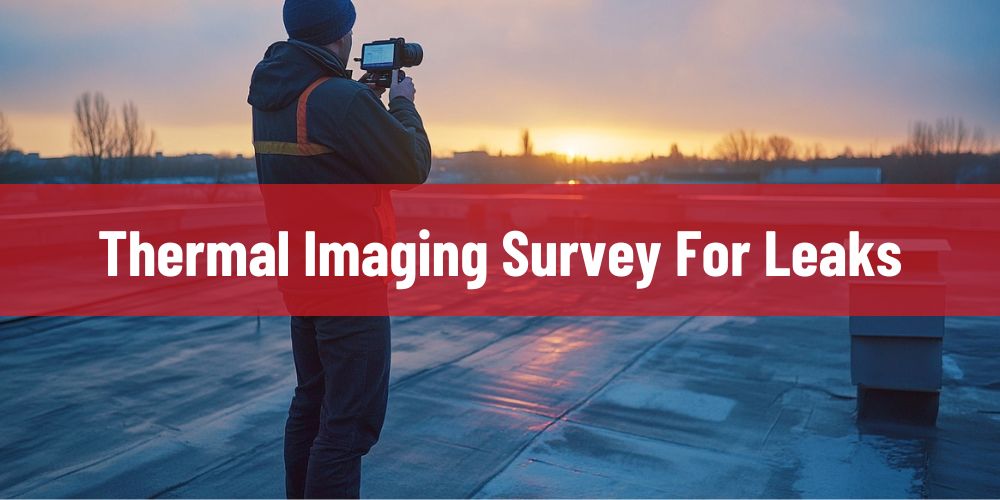
Pinpoint Leak Detection provides thermal imaging surveys for leaks across commercial, industrial, residential-block, education, healthcare, hospitality, retail, logistics, and managed-property buildings in London and the South East. Thermal imaging surveys for leaks are a non-invasive diagnostic service that connects infrared thermography, temperature-pattern analysis, moisture-retention screening, roof build-up behaviour, leak-risk interpretation, repair targeting, and evidence-led asset management, so their value depends on more than producing colourised thermal images. A properly controlled thermal imaging survey uses infrared camera capture, visible-light comparison images, thermal contrast assessment, anomaly location records, survey timing control, weather-condition review, roof-detail inspection, surface-temperature interpretation, and verification planning to identify where retained moisture, wet insulation, membrane defects, drainage issues, heat-release variation, evaporation effects, or concealed water movement may be affecting the roof system.
Thermal imaging surveys for leaks in London and the South East operate under roof-construction, weather, access, occupancy, drainage, and building-density conditions that directly affect whether meaningful thermal contrast can be captured and interpreted. Inner London buildings often involve occupied offices, retail premises, apartment blocks, schools, healthcare buildings, hospitality venues, roof terraces, podium decks, parapet-contained flat roofs, plant-congested roof zones, hidden rear roof areas, restricted access routes, live entrances, party-wall interfaces, older overlays, and retained building fabric where concealed moisture may sit below membranes, finishes, or insulation layers without a clear visible defect. Outer London and South East properties often involve larger warehouse roofs, logistics units, retail parks, business parks, industrial estates, hotels, care homes, schools, residential blocks, and multi-building estates where thermal patterns may extend across broad roof zones, drainage falls, outlet runs, rooflight rows, plant areas, service penetrations, parapet edges, extension interfaces, and historic repair areas. In these conditions, thermal survey quality is determined by temperature differential, survey timing, roof surface condition, recent rainfall, wind exposure, solar loading, material emissivity, insulation behaviour, access coverage, visible-image comparison, anomaly interpretation, and whether the thermal evidence needs confirmation through moisture mapping, electronic leak detection, controlled hose testing, targeted opening-up, core sampling, or repair verification.
- Retained moisture and roof-temperature anomalies → can occur within insulation layers, beneath membranes, below liquid coatings, around outlets, beside rooflight kerbs, near service penetrations, across ponding zones, around plant plinths, along parapet upstands, within terrace build-ups, and across historic overlay areas → wet roof zones can heat, cool, retain energy, evaporate, or release temperature differently from dry roof zones depending on roof build-up, insulation type, survey timing, and environmental conditions → hidden saturation, recurring damp, reduced insulation performance, corrosion risk, mould risk, internal water damage, and premature roof deterioration increase when thermal anomalies are not identified and verified as part of leak diagnosis.
- Survey timing, weather stability, and usable thermal contrast → control whether infrared thermography can show meaningful moisture-related temperature differences across membranes, roof coverings, insulation zones, parapets, gutters, outlets, rooflights, service penetrations, plant areas, and drainage paths → thermal evidence can be weakened by rain at the wrong time, standing surface water, high wind, rapid temperature change, insufficient temperature differential, solar glare, shaded roof sections, reflective materials, inconsistent construction, or recent repair materials → false positives, missed wet zones, inconclusive imagery, weak evidence, and poor repair decisions increase when thermal imaging is carried out without the environmental conditions required for reliable interpretation.
- Large commercial roof areas and spatial moisture behaviour → place interpretation pressure on outlet-centred wetting, ponding-zone retention, parapet-side moisture, lap-line migration, plant-area dampness, gutter-adjacent staining, rooflight-row defects, service-route leaks, extension-interface failures, and repeated historic repair zones → thermal patterns must be interpreted as roof-system behaviour rather than isolated colour patches because water can spread through insulation, deck interfaces, drainage falls, vapour-control defects, roof voids, or previous repair interfaces → wrong-area repairs, under-scoped works, over-repair, missed wet insulation, fragmented maintenance planning, and recurring leaks increase when thermal imagery is not read spatially across the full roof area.
- Thermal imaging suitability and confirmation limits → determine whether infrared thermography is appropriate as screening evidence or whether moisture mapping, electronic leak detection, drone roof surveying, controlled hose testing, core sampling, targeted opening-up, or post-repair verification is required → thermal anomalies can be influenced by membrane colour, material emissivity, insulation type, metal decks, ballast, overburden, roof traffic, reflective surfaces, trapped vapour, surface contamination, recent rainfall, and construction changes across the roof area → disputed findings, unnecessary strip-up, duplicated investigation, unresolved leaks, and false confidence increase when thermal images are treated as final proof without method suitability checks and verification logic.
- Insurance, landlord, facilities, contractor, and lifecycle-planning evidence → requires thermal image records, visible-light reference images, anomaly locations, survey timing, weather context, temperature-pattern explanation, likely moisture behaviour, affected roof zones, uncertainty level, recommended verification points, and repair or replacement implications → infrared images without structured interpretation do not provide enough diagnostic evidence for insurers, freeholders, managing agents, contractors, maintenance teams, leaseholders, surveyors, asset managers, or building occupiers → delayed approvals, disputed scope, uncertain pricing, fragmented maintenance records, poor repair targeting, and weak long-term roof investment decisions increase when thermal findings are not converted into a usable leak and moisture-evidence report.
Pinpoint Leak Detection delivers thermal imaging surveys for leaks as a controlled infrared thermography, moisture-screening, and diagnostic-escalation service, assessing internal damp evidence, roof construction, membrane or covering condition, insulation type, drainage behaviour, ponding areas, parapet and outlet details, plant congestion, rooflight and penetration risk, surface-temperature variation, emissivity factors, weather timing, temperature differential, rainfall and wind conditions, access coverage, visible-image comparison, anomaly location, interpretation confidence, verification requirements, reporting purpose, lifecycle context, and whether the findings require moisture mapping, electronic leak detection, drone roof surveying, controlled hose testing, targeted opening-up, core sampling, on-the-spot minor repair, arranged follow-on repairs, planned maintenance, refurbishment, or replacement before defining the correct diagnostic and remedial strategy.
What Can Thermal Imaging Show During a Leak Survey?
Thermal imaging can show temperature patterns that indicate where moisture may be retained, where wet insulation may be affecting roof performance, and where a leak-related condition may need further verification. Pinpoint Leak Detection uses infrared thermography to identify thermal anomalies across roof membranes, coverings, insulation zones, drainage areas, rooflights, penetrations, parapets, plant bases, gutters, outlets, terrace build-ups, and previous repair areas. A thermal imaging survey does not treat colour variation as automatic proof of a leak; it interprets heat-retention behaviour, cooling patterns, evaporation effects, material response, survey timing, roof construction, and visible roof condition to decide whether the anomaly is likely to represent retained moisture, a construction change, surface contamination, solar loading, trapped vapour, or another roof-performance factor.
Across London and the South East, thermal imaging is most useful where roof condition cannot be understood from surface appearance alone. Inner London buildings may involve occupied offices, retail premises, schools, healthcare buildings, hospitality venues, apartment blocks, roof terraces, podium decks, parapet-contained flat roofs, hidden rear roof areas, narrow access routes, older overlays, plant-congested roofs, party-wall interfaces, and live entrances where concealed moisture can sit beneath membranes, finishes, insulation layers, or terrace build-ups without an obvious visible defect. Outer London and South East properties may involve warehouse roofs, logistics units, retail parks, business parks, industrial estates, hotels, care homes, schools, residential blocks, long drainage runs, rooflight rows, service penetrations, plant areas, gutter lines, extension interfaces, and multi-building estates where thermal patterns can help separate isolated anomalies from wider roof moisture behaviour.
- Retained moisture and suspected wet insulation zones → thermal imaging may show areas that heat, cool, retain energy, or release temperature differently from surrounding dry roof zones → these patterns can occur where moisture is held within insulation, beneath membranes, below coatings, around rooflights, near outlets, beside parapets, within terrace build-ups, or around previous repair areas → repair and refurbishment decisions improve when suspected wet zones are identified for verification rather than missed because the roof surface appears visually intact.
- Thermal anomalies around likely leak-risk details → rooflights, upstands, service penetrations, plant plinths, pipe entries, cable routes, flashing interfaces, gutter edges, outlet bowls, parapet returns, and lap lines can produce abnormal temperature signatures where moisture, water loading, failed detailing, or material change affects heat behaviour → these details often interrupt the main roof covering and are more vulnerable to movement, ponding, vibration, wind-driven rain, and maintenance traffic → leak investigation becomes more targeted when thermal anomalies are linked to specific roof details rather than treated as random colour patches.
- Moisture spread across larger roof areas → thermal imaging can help identify whether a suspected issue is localised, outlet-centred, ponding-related, parapet-side, plant-zone based, lap-following, terrace-associated, or spread across broader insulation areas → this matters on larger commercial roofs where water can migrate through insulation layers, deck interfaces, drainage falls, vapour-control weaknesses, overlays, and previous repair edges → under-scoped repair, unnecessary replacement, missed saturation, and recurring damp are reduced when the thermal pattern is interpreted spatially across the roof system.
- Drainage-related temperature behaviour → ponding fields, blocked outlets, low falls, valley channels, gutter-adjacent zones, scupper areas, overflow stains, and parapet-contained drainage routes may show different thermal behaviour where water has been retained or evaporation has altered the roof surface temperature → these findings can indicate areas where drainage pressure is contributing to membrane ageing, coating breakdown, insulation wetting, corrosion risk, or repeated water ingress → maintenance priorities become clearer when the survey connects thermal evidence with how rainfall is collected, slowed, trapped, or discharged.
- Areas where visual inspection is incomplete or inconclusive → thermal imaging can support roof surveys where visible defects do not explain internal damp, where previous repairs obscure the original failure point, where overlays hide older roof layers, or where access limits prevent close inspection of every detail → infrared evidence can highlight zones that need moisture mapping, electronic leak detection, drone roof surveying, controlled hose testing, core sampling, targeted opening-up, or post-repair verification → uncertainty is reduced when the thermal survey identifies where stronger diagnostic evidence should be gathered.
- Evidence for repair targeting and roof asset decisions → thermal image records, visible-light comparison photographs, anomaly locations, weather context, survey timing, temperature-pattern interpretation, and verification recommendations can support landlords, insurers, managing agents, facilities teams, roofing contractors, surveyors, leaseholders, asset managers, and building owners → the findings can help define whether the next step is local repair, temporary protection, moisture verification, insulation replacement, follow-on remedial works, refurbishment planning, or replacement assessment → approval delays, disputed scope, wasted repair effort, and weak lifecycle planning are reduced when thermal evidence is converted into a practical diagnostic and remedial route.
Pinpoint Leak Detection uses thermal imaging during leak surveys to show where roof temperature behaviour may indicate retained moisture, wet insulation, leak-risk details, drainage-related water retention, concealed moisture spread, or roof areas requiring verification. The value is not the infrared image alone; it is the interpretation of thermal contrast against roof build-up, weather timing, visible condition, access coverage, anomaly location, and the remedial decision that follows.
Have a question about leak detection?
How Are Thermal Anomalies Captured and Interpreted?
Thermal anomalies are captured by using infrared camera survey work to record surface-temperature variation across the roof, then comparing those temperature patterns against visible roof condition, roof construction, moisture behaviour, weather timing, and known leak-risk details. Pinpoint Leak Detection does not interpret a thermal anomaly as a leak simply because it appears warmer, cooler, brighter, darker, or different from the surrounding roof field. The anomaly must be assessed against roof build-up, membrane type, insulation behaviour, drainage layout, surface moisture, solar loading, wind exposure, material emissivity, recent rainfall, access coverage, and visible-light reference images before it can be treated as useful diagnostic evidence.
Across London and the South East, anomaly capture and interpretation are shaped by building density, access restrictions, live occupancy, roof complexity, and roof-area scale. Inner London buildings may involve occupied offices, schools, healthcare premises, retail units, hospitality venues, apartment blocks, roof terraces, podium decks, parapet-contained flat roofs, hidden rear elevations, party-wall interfaces, older overlays, restricted access routes, live entrances, and plant-congested roof zones where thermal images must be read carefully against construction variation and limited survey angles. Outer London and South East properties may involve warehouse roofs, logistics units, retail parks, business parks, industrial estates, care homes, hotels, schools, residential blocks, long drainage runs, rooflight rows, service penetrations, plant areas, gutter lines, extension interfaces, and multi-building estates where thermal patterns may need to be interpreted across large roof zones rather than isolated image frames.
- Infrared images are captured under controlled survey conditions → the survey records surface-temperature behaviour across membranes, coverings, rooflights, outlets, gutters, parapets, plant zones, service penetrations, ponding areas, terrace build-ups, and previous repair zones → useful image capture depends on timing, access, temperature differential, roof coverage, camera position, weather stability, and the absence of misleading surface conditions → interpretation becomes more reliable when the thermal survey is planned around the conditions needed to reveal meaningful contrast.
- Visible-light reference images are used alongside thermal images → photographic comparison helps connect each thermal anomaly to a real roof feature, defect location, drainage route, repair patch, outlet position, rooflight row, penetration detail, parapet edge, plant plinth, or surface condition → this prevents the thermal image from becoming an abstract colour record with no construction context → repair targeting improves when infrared evidence is tied to identifiable roof locations and visible roof details.
- Thermal contrast is interpreted against roof build-up → membranes, insulation type, deck construction, coatings, overlays, asphalt areas, metal components, terrace finishes, ballast, vapour-control layers, and previous repair materials can all affect heat retention and release → the same temperature pattern may mean retained moisture on one roof build-up but material change, shading, surface contamination, or construction variation on another → false positives and false confidence are reduced when thermal anomalies are read through the actual roof assembly.
- Moisture-related anomalies are separated from non-moisture effects → retained moisture, wet insulation, evaporation, ponding residue, damp overlays, and concealed water movement can create abnormal temperature behaviour, but so can solar loading, wind cooling, reflective surfaces, membrane colour, plant shadows, roof traffic, trapped vapour, dirt, moss, debris, and recent repair materials → each anomaly must be tested against likely environmental and material causes → diagnostic quality improves when the survey distinguishes probable moisture evidence from thermal noise.
- Anomaly location is interpreted spatially across the roof → outlet-centred patterns, parapet-side anomalies, rooflight-row signatures, ponding-field variation, lap-following marks, plant-zone differences, gutter-adjacent cooling, terrace build-up behaviour, and extension-interface anomalies can reveal how water may be retained or moving through the roof system → this spatial reading is especially important on larger roofs where moisture may travel away from the original entry point → under-scoped repairs and missed wet zones are reduced when thermal anomalies are assessed as connected roof behaviour rather than isolated hot or cold patches.
- Interpretation defines the verification route → a thermal anomaly may support a recommendation for roof moisture mapping, electronic leak detection, controlled hose testing, drone roof surveying, core sampling, targeted opening-up, repair verification, or follow-on inspection where the thermal evidence is suggestive but not conclusive → reports should identify anomaly location, likely cause, confidence level, weather context, visible-image comparison, limitations, and recommended next action → landlords, insurers, managing agents, facilities teams, contractors, surveyors, asset managers, leaseholders, and building owners gain stronger evidence when thermal findings are converted into a clear verification and remedial pathway.
Pinpoint Leak Detection captures and interprets thermal anomalies by combining infrared imaging with visible evidence, roof-system knowledge, weather-condition review, access coverage, temperature-pattern analysis, and verification planning. The result is not a colour image presented as proof; it is a controlled interpretation of where thermal behaviour may indicate retained moisture, wet insulation, drainage-related water retention, construction variation, or a roof zone that requires further diagnostic confirmation.
Want a price for leak detection?
What Conditions Affect Thermal Imaging Survey Accuracy?
Thermal imaging survey accuracy depends on whether the roof can produce meaningful temperature contrast that can be interpreted against the actual roof build-up, surface condition, weather history, and moisture behaviour. Pinpoint Leak Detection does not treat infrared thermography as a universal leak-finding method, because thermal images can be distorted by poor timing, insufficient temperature differential, recent rainfall, standing surface water, wind cooling, solar loading, reflective materials, roof contamination, mixed construction, insulation type, membrane colour, ballast, overburden, and access gaps. A reliable thermal imaging survey requires controlled conditions, careful anomaly interpretation, visible-image comparison, and clear verification logic before thermal evidence is used to guide repair, moisture mapping, targeted opening-up, refurbishment, or replacement decisions.
Across London and the South East, accuracy conditions are often complicated by dense building layouts, occupied premises, variable roof access, older overlays, plant congestion, terrace build-ups, drainage defects, and mixed roof materials. Inner London buildings may involve offices, schools, healthcare premises, retail units, hospitality venues, apartment blocks, podium decks, roof terraces, parapet-contained flat roofs, live entrances, hidden rear elevations, party-wall interfaces, retained fabric, older repair layers, and plant-heavy roof zones where thermal contrast can be interrupted by shade, restricted survey angles, surface finishes, and construction changes. Outer London and South East properties may involve warehouse roofs, logistics units, retail parks, business parks, industrial estates, hotels, care homes, schools, residential blocks, long drainage runs, rooflight rows, gutter lines, service penetrations, extension interfaces, broad roof areas, and multi-building estates where wind exposure, solar gain, ponding, outlet behaviour, and roof-zone variation can affect how thermal patterns are captured and read.
- Survey timing and temperature differential → thermal imaging is most useful when wet and dry roof zones display enough temperature difference to be distinguished reliably → time of day, overnight cooling, daytime heating, roof heat retention, seasonal conditions, internal heat loss, and the rate at which the roof surface warms or cools can all affect image quality → inconclusive results become more likely when the survey is carried out before the roof has developed usable thermal contrast.
- Rainfall history, surface water, and drying behaviour → recent rain can help reveal moisture-related behaviour in some circumstances, but standing water, active rainfall, saturated surfaces, ponding fields, wet debris, and uneven drying can also mask or exaggerate thermal patterns → retained moisture below the surface must be separated from water sitting on top of the membrane or evaporating from contamination → interpretation improves when rainfall timing, roof drainage, surface wetness, and evaporation behaviour are recorded as part of the survey context.
- Wind, solar loading, shade, and environmental exposure → wind can cool exposed roof areas quickly, while solar loading, shade from plant, parapets, neighbouring buildings, rooflights, service equipment, and elevation changes can create temperature variation unrelated to leaks → reflective glare, uneven heating, rapid weather shifts, and shaded roof sections may produce thermal patterns that resemble moisture anomalies → false positives are reduced when environmental effects are checked before a temperature difference is treated as diagnostic evidence.
- Roof material, emissivity, and construction variation → single-ply membranes, bituminous felt, asphalt, liquid-applied coatings, metal decks, foil-faced insulation, ballast, terrace finishes, concrete decks, overlays, patch materials, plant supports, and different membrane colours can all emit, reflect, retain, or release heat differently → a thermal anomaly may reflect material behaviour rather than retained moisture → survey accuracy improves when infrared findings are interpreted against the roof’s actual construction rather than judged from the image colour alone.
- Access coverage, viewing angle, and roof-zone consistency → restricted ladders, fragile rooflights, unsafe edges, plant congestion, parapet obstructions, hidden rear elevations, live entrances, tenant areas, overburden, and roof terraces can prevent consistent thermal coverage across every roof zone → incomplete access may leave outlets, gutters, upstands, plant areas, penetrations, parapet edges, or previous repair zones insufficiently assessed → evidence quality improves when the report states what was captured directly, what was limited, and whether drone roof surveying, controlled access, targeted opening-up, or follow-on inspection is needed.
- Verification requirements and decision consequence → thermal imaging can indicate likely moisture behaviour, wet insulation risk, drainage-related water retention, or concealed roof anomalies, but it may not provide final proof of membrane breach, leak source, saturation depth, insulation condition, or repair boundary → where findings affect major repair, insurance, refurbishment, replacement, warranty, or landlord decisions, moisture mapping, electronic leak detection, core sampling, controlled hose testing, targeted opening-up, or post-repair verification may be required → over-scoping, under-scoping, disputed findings, and weak repair decisions are reduced when thermal evidence is verified in proportion to the consequence of the decision.
Pinpoint Leak Detection assesses thermal imaging survey accuracy by reviewing timing, temperature differential, rainfall history, surface condition, wind exposure, solar loading, material emissivity, roof construction, drainage behaviour, access coverage, anomaly location, and verification requirement. The survey is strongest when infrared evidence is treated as controlled diagnostic information: useful for identifying suspected retained moisture and roof zones requiring further investigation, but always interpreted against site conditions before repair or asset-management decisions are made.
When Does Thermal Imaging Need Further Verification?
Thermal imaging needs further verification when an infrared anomaly suggests retained moisture, wet insulation, concealed water movement, drainage-related saturation, or a possible leak-risk zone but does not prove the exact defect, depth, boundary, or repair requirement on its own. Pinpoint Leak Detection treats thermal imaging as controlled diagnostic evidence, not automatic final proof of a leak source. Verification becomes necessary where the thermal pattern could be influenced by roof build-up, membrane colour, material emissivity, recent rainfall, standing water, wind cooling, solar loading, reflective surfaces, ballast, overburden, insulation type, historic repairs, surface contamination, or construction changes that may produce temperature variation without confirming active water ingress.
Across London and the South East, verification is especially important where roof decisions carry cost, disruption, liability, or asset-management consequence. Inner London buildings may involve occupied offices, retail premises, schools, healthcare buildings, hospitality venues, apartment blocks, podium decks, roof terraces, parapet-contained flat roofs, hidden rear roof areas, party-wall interfaces, older overlays, retained fabric, live entrances, restricted access routes, and plant-congested roof zones where a thermal anomaly may need confirmation before intrusive works, tenant disruption, scaffold access, or repair approval is justified. Outer London and South East properties may involve warehouse roofs, logistics units, retail parks, business parks, industrial estates, care homes, hotels, schools, residential blocks, long drainage runs, rooflight rows, service penetrations, plant areas, gutter lines, extension interfaces, large insulation fields, and multi-building estates where verification helps separate isolated thermal variation from wider moisture spread or roof-system deterioration.
- The thermal anomaly does not identify a definite leak source → infrared images may show abnormal heat retention, cooling behaviour, evaporation effects, or wet-zone indicators without proving the exact membrane breach, lap failure, outlet defect, penetration fault, flashing weakness, rooflight kerb issue, or parapet entry point → where the thermal pattern narrows the suspect area but does not prove the water-entry mechanism, roof leak investigation, electronic leak detection, controlled hose testing, targeted opening-up, or repair verification may be required → wrong-area repairs are reduced when thermal evidence is used to guide confirmation rather than replace confirmation.
- The suspected moisture extent affects repair or refurbishment scope → thermal imaging may indicate that moisture is localised, outlet-centred, ponding-related, parapet-side, plant-zone based, lap-following, terrace-associated, or spread beneath a wider insulation area → where the size of the wet zone affects local repair, insulation replacement, overlay suitability, partial refurbishment, replacement budgeting, or lifecycle planning, roof moisture mapping, core sampling, targeted opening-up, or repeat scanning may be needed → over-scoped replacement and under-scoped repair are reduced when suspected saturation boundaries are verified before works are approved.
- Roof construction could distort the infrared pattern → metal decks, foil-faced insulation, asphalt sections, liquid coatings, single-ply membranes, bituminous felt, concrete decks, ballast, terrace finishes, overlaid systems, plant supports, patch materials, vapour-control layers, and different membrane colours can all change thermal response → an anomaly may reflect construction variation, material change, trapped vapour, shading, or surface contamination rather than retained moisture → verification improves diagnostic reliability where the roof build-up makes thermal interpretation uncertain.
- Weather or survey conditions reduce confidence → recent rainfall, standing surface water, rapid drying, high wind, low temperature differential, solar glare, heavy shade, active rainfall, roof contamination, or uneven heating can weaken the relationship between temperature pattern and moisture condition → the survey may still identify useful suspect zones, but the confidence level should be limited if environmental conditions were not ideal → repeat thermal imaging, moisture mapping, controlled access, or targeted inspection may be needed before the anomaly is used as the basis for major repair decisions.
- Access limitations prevent complete roof confirmation → fragile rooflights, unsafe edges, live entrances, tenant areas, public interfaces, plant congestion, parapet obstructions, roof terraces, hidden rear elevations, ballasted areas, overburden, or restricted ladders may prevent the survey from confirming every affected detail directly → where thermal evidence is partial, the report should identify inspected areas, excluded zones, viewing limitations, and recommended follow-up methods such as drone roof surveying, MEWP access, scaffold access, targeted opening-up, or specialist inspection → unsupported conclusions are reduced when incomplete thermal coverage is treated as an evidence gap.
- The finding will be used for insurance, landlord, contractor, or capital decisions → insurers, landlords, managing agents, freeholders, facilities teams, roofing contractors, surveyors, leaseholders, asset managers, and building owners may need stronger proof before approving strip-up, repair scope, replacement work, warranty review, liability discussion, or lifecycle budgeting → verification can provide supporting evidence through roof moisture mapping, electronic leak detection, controlled hose testing, core sampling, targeted opening-up, post-repair verification, or follow-on roof survey work → disputed findings, delayed approvals, uncertain pricing, and weak repair records are reduced when thermal anomalies are verified in proportion to the decision they are expected to support.
Pinpoint Leak Detection recommends further verification when thermal imaging identifies a meaningful anomaly but the source, moisture extent, construction influence, access limitation, confidence level, or remedial consequence still needs stronger evidence. The purpose of verification is to convert infrared temperature-pattern evidence into a defensible diagnostic route, so the next action is based on confirmed moisture behaviour, confirmed waterproofing condition, confirmed repair boundary, or clearly stated uncertainty rather than an unverified thermal image.
Why Choose Pinpoint Leak Detection for Thermal Imaging Surveys for Leaks?
Pinpoint Leak Detection is chosen for thermal imaging surveys for leaks where the building needs controlled infrared evidence rather than a colour image presented without diagnostic context. The service connects infrared thermography, survey timing, temperature-pattern interpretation, visible-light comparison, roof build-up knowledge, moisture-risk screening, drainage behaviour, anomaly location, access coverage, verification requirements, and repair consequence into one evidence-led survey process. This means thermal findings are assessed as part of the roof system, not treated as standalone proof of a leak source, wet insulation zone, membrane breach, or replacement requirement without supporting interpretation.
Across London and the South East, thermal imaging surveys for leaks need to account for the way real buildings affect thermal evidence. Inner London sites may involve occupied offices, schools, healthcare premises, retail units, hospitality venues, apartment blocks, podium decks, roof terraces, parapet-contained flat roofs, party-wall interfaces, hidden rear roof areas, retained fabric, live entrances, narrow access routes, older overlays, and plant-congested roof zones where moisture may be concealed below membranes, finishes, insulation layers, or terrace build-ups. Outer London and South East properties may involve warehouse roofs, logistics units, retail parks, business parks, industrial estates, care homes, hotels, schools, residential blocks, long drainage runs, rooflight rows, gutter lines, service penetrations, plant areas, extension interfaces, large insulation fields, and multi-building estates where thermal anomalies must be read across broad roof areas and not as isolated image colours.
- Thermal evidence is interpreted through roof construction → membranes, coatings, felt systems, asphalt areas, single-ply roofs, metal decks, concrete decks, insulation type, vapour-control layers, overlays, patch materials, terrace finishes, ballast, plant supports, and different membrane colours can all affect surface-temperature behaviour → Pinpoint Leak Detection assesses whether a thermal anomaly is likely to indicate retained moisture, wet insulation, construction variation, material change, surface contamination, solar loading, trapped vapour, or another roof-performance factor → false confidence is reduced when infrared findings are interpreted through the actual roof assembly rather than judged from image colour alone.
- Survey timing and environmental conditions are treated as evidence controls → temperature differential, recent rainfall, drying behaviour, wind exposure, solar gain, shade, surface water, roof contamination, reflective materials, and rapid weather change can all strengthen or weaken the reliability of thermal contrast → the survey records the conditions that affect whether retained moisture or wet insulation can be distinguished from environmental noise → image quality and reporting confidence improve when thermal capture is planned around the conditions needed for meaningful interpretation.
- Anomalies are linked to real roof locations and visible details → thermal patterns are compared with visible-light images, roof plans where available, drainage routes, outlet positions, rooflight rows, parapet edges, penetration details, plant plinths, gutter lines, ponding areas, terrace zones, and previous repair patches → this prevents infrared evidence from becoming an abstract colour record detached from the building → repair targeting becomes more practical when each anomaly is connected to a roof zone, roof detail, likely moisture behaviour, and recommended verification route.
- Moisture-risk screening is separated from final proof → thermal imaging can indicate suspected retained moisture, wet insulation risk, evaporation behaviour, drainage-related saturation, concealed water movement, or areas requiring further investigation, but it may not prove the exact membrane breach, saturation depth, repair boundary, or leak mechanism on its own → Pinpoint Leak Detection states confidence level, limitations, likely causes, and verification needs where the thermal evidence is suggestive rather than conclusive → wrong-area repairs, unnecessary strip-up, disputed findings, and missed wet zones are reduced when thermal imaging is used as diagnostic evidence rather than overclaimed as final proof.
- Verification routes are selected around the decision being made → where the thermal finding affects repair scope, insurance evidence, landlord approval, contractor instruction, refurbishment planning, replacement budgeting, warranty review, or lifecycle strategy, further confirmation may be recommended through roof moisture mapping, electronic leak detection, controlled hose testing, drone roof surveying, core sampling, targeted opening-up, follow-on roof survey work, or post-repair verification → each method is selected to answer a defined evidence gap such as moisture extent, waterproofing continuity, source location, or repair boundary → decision quality improves when verification is proportional to the consequence of the finding.
- Reports are structured for usable roof decisions → findings can include infrared images, visible-light reference photographs, anomaly locations, roof-zone descriptions, weather context, survey timing, temperature-pattern explanation, suspected moisture behaviour, affected details, access limitations, uncertainty level, recommended verification points, and repair or asset-management implications → this structure supports insurers, landlords, managing agents, facilities teams, roofing contractors, surveyors, leaseholders, asset managers, freeholders, and building owners → approvals, pricing, repair targeting, maintenance planning, and lifecycle decisions become stronger when thermal imaging findings are converted into a clear diagnostic and remedial pathway.
Pinpoint Leak Detection provides thermal imaging surveys for leaks as a controlled infrared thermography and moisture-risk interpretation service for roofs where surface appearance does not explain the building’s leak, damp, or moisture concern. The value is in connecting thermal contrast, roof construction, weather timing, anomaly location, visible evidence, verification logic, and remedial consequence so the survey supports targeted investigation, repair planning, refurbishment decisions, or replacement assessment without overstating what thermal imagery can prove on its own.
When Should a Property Request a Thermal Imaging Survey for Leaks?
A property should request a thermal imaging survey for leaks when the visible roof condition does not fully explain internal damp, recurring water ingress, suspected wet insulation, concealed moisture spread, or the likely extent of roof-system saturation. This is especially relevant where there are intermittent leaks, damp patches below flat roofs, ceiling staining after rainfall, unexplained mould, repeated repairs, ponding areas, outlet-centred moisture concerns, rooflight-row leaks, parapet-side damp, plant-zone water entry, service-penetration defects, terrace or podium build-ups, historic overlays, suspected trapped moisture, or uncertainty over whether the next step should be local repair, moisture mapping, electronic leak detection, targeted opening-up, core sampling, insulation replacement, refurbishment, or replacement assessment. A thermal imaging survey should also be requested before major repair or refurbishment decisions where the building owner, landlord, insurer, managing agent, facilities team, surveyor, roofing contractor, leaseholder, asset manager, or occupier needs infrared evidence to identify likely moisture-risk zones and decide where stronger verification is required.
Across London and the South East, a thermal imaging survey for leaks should be requested early where concealed moisture could affect repair scope, tenant disruption, insurance evidence, contractor pricing, or long-term roof investment. Inner London offices, retail premises, schools, healthcare buildings, hospitality venues, apartment blocks, roof terraces, podium decks, parapet-contained flat roofs, hidden rear roof areas, party-wall interfaces, older overlays, retained building fabric, live entrances, narrow access routes, and plant-congested roof zones often need controlled infrared evidence where moisture may sit beneath membranes, finishes, insulation layers, or terrace build-ups without a clear surface defect. Outer London and South East warehouses, logistics buildings, retail parks, business parks, industrial estates, care homes, hotels, schools, residential blocks, long drainage runs, rooflight rows, service penetrations, plant areas, gutter lines, extension interfaces, large insulation fields, historic repair zones, and multi-building estates often need thermal imaging to separate isolated temperature anomalies from wider retained-moisture behaviour. Pinpoint Leak Detection provides thermal imaging surveys for leaks when the next decision depends on connecting infrared thermography, survey timing, temperature-pattern interpretation, visible-light comparison, roof construction, weather context, anomaly location, verification requirement, and remedial consequence into a clear diagnostic route.